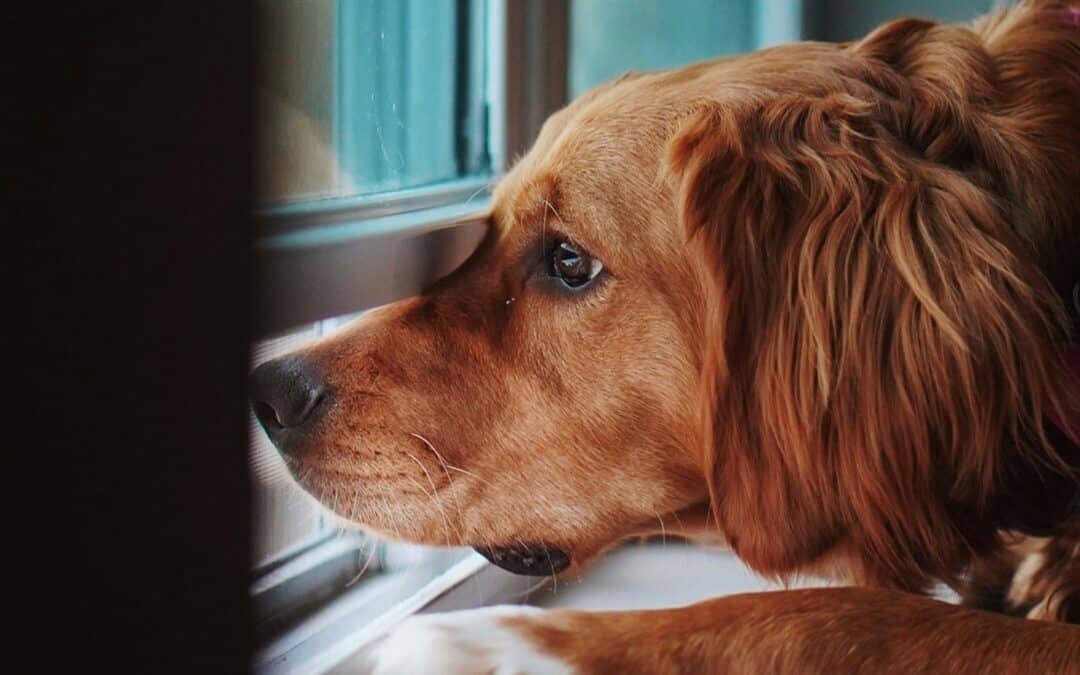
The thunder rolls in, and suddenly your dog is pressed against your legs, trembling and panting, looking up at you like you might be able to make it stop. Every instinct you have says to wrap her up and tell her it’s okay. And then a little voice chimes in with something you heard years ago: comforting a scared dog only rewards the fear.
But here’s the truth: Comforting a dog who is scared of storms or fireworks does not reinforce the fear. That’s because fear is an emotion, not a behavior performed for a reward. Correcting or ignoring a panicking dog is what tends to make noise anxiety worse.
If you’ve ever hesitated in that moment, you’re far from alone. You can let that voice go, and understanding what’s really happening in your dog’s body can help you both get through the next storm.
Why Comforting a Scared Dog Doesn’t Reinforce Fear
The worry makes more sense once you know how reinforcement works. It shapes behaviors a dog chooses to repeat because they pay off, like sitting politely because a treat usually follows. Panic during thunder isn’t that kind of choice.
When a storm cracks overhead, your dog’s body reacts before they have time to think, the same way your own heart might race before you’ve consciously registered what startled you.
A soothing voice can’t teach a dog to be more afraid of thunder. What your presence can do is help your dog feel a little less alone with something overwhelming.
You wouldn’t tell a scared child to tough it out alone in a storm. Dogs don’t need that either. Comfort doesn’t create fear.
Why the “Don’t Comfort a Fearful Dog” Advice Stuck Around
The idea came from older training thinking that treated every behavior, fear included, as something attention could accidentally strengthen. It sounds logical, and plenty of caring pet parents were told it by people they trusted.
But fear doesn’t work like a trick, and holding back comfort doesn’t teach a dog that storms are safe. It only leaves them to cope with their fear on their own.
There is one grain of truth worth keeping: how you comfort matters. Dogs read our body language closely. A frantic, high-pitched “it’s okay, it’s okay!” can sound like you’re worried too.
A slow, steady voice and a relaxed body tell your dog that you aren’t afraid, and that’s the message you want them to hear.
How to Comfort a Dog During a Storm or Fireworks
You don’t need special gear to help a frightened dog. Comforting a dog during a storm or fireworks comes down to staying calm, staying close, and letting your dog decide what feels safest:
- Stay close and steady. Sit nearby, speak slowly and softly, and offer gentle, slow petting or light pressure if your dog leans into you.
- Follow their lead. Some dogs want to be in your lap. Others want to hide. If your dog retreats under a bed or into the bathtub, let them, and don’t pull them out.
- Offer a safe space. An interior room, a covered crate with the door open, or a quiet closet can muffle sound and feel protected.
- Muffle the noise. Close windows and curtains, and use white noise, a fan, or calm music.
- Offer, don’t force, treats or chews. A long-lasting chew can help some dogs settle, but a dog too scared to eat is telling you something about their stress level.
- Prevent escapes. Keep doors and gates secured and make sure ID tags and microchip details are current. Fireworks are a common cause of lost pets.
What Doesn’t Help a Dog Who Is Scared of Storms
Some older advice goes further than “don’t comfort” and suggests a firm “no,” or a sharp correction to snap a dog out of it. But it doesn’t work, because barking, pacing, and scratching during a storm are panic responses, not defiance.
A correction doesn’t teach a dog that the storm is safe. It teaches them that you, the person they trust most, can become something to be afraid of too, right when they need you most.
Sometimes a dog who has been corrected enough times goes quiet and still, and it can look like the approach worked. What’s more likely is that the dog has learned that showing fear leads to more trouble, so they’ve stopped showing it. Not because they feel safe, but because they’ve quietly given up trying to tell you they don’t.
What Research Says About Fear, Comfort, and Correction in Dogs
Veterinary behavior research consistently links reward-based, supportive approaches with better outcomes for fearful dogs, and punishment-based methods with more fear, not less.
The American Veterinary Society of Animal Behavior (AVSAB) reviewed the evidence in its 2021 position statement on humane dog training. It found that aversive methods are associated with “increased anxiety and fear-related aggression, avoidance, and learned helplessness,” and it recommends only reward-based methods. For fear specifically, AVSAB says creating positive associations with what frightens a dog “is essential in easing fear and anxiety.” (AVSAB Humane Dog Training Position Statement, 2021)
A 2009 survey from the University of Pennsylvania School of Veterinary Medicine, published in Applied Animal Behaviour Science, found that several confrontational techniques triggered aggressive responses in at least a quarter of the dogs they were used on, while gentler approaches like rewards and extra exercise rarely did. (Herron, Shofer and Reisner, 2009)
“You wouldn’t tell a scared child to tough it out alone in a storm. Dogs don’t need that either. Comfort doesn’t create fear.”
Two Dogs Scared of Storms, One Year Later
Picture two dogs a year from now. One was corrected every time he panicked during a storm. His visible reactions got smaller for a while, which felt like progress, until one night his family came home to a door frame clawed to splinters after a storm rolled through while they were out.
His fear never actually went away. It just went quiet when someone was watching.
The other dog was comforted through every storm, and spent that same year hearing quiet recordings of thunder paired with his favorite treats, a little louder each week, always at a volume he could handle without panicking.
A year later, he sleeps through storms that used to send him hiding in the bathtub. Same fear to start. A completely different year, because one plan addressed what he was feeling inside, and the other only asked him to hide it better.
How to Help a Dog Who Is Scared of Storms Long-Term
Comfort helps your dog get through tonight. The lasting fix for a dog’s fear of storms or fireworks is gradual desensitization and counterconditioning. That means reintroducing the sound at a very low volume, paired with something your dog loves, and building up slowly, session by session, until the sound no longer means danger.
Starting weeks before storm season or the Fourth of July works far better than starting the night of.
It takes patience, and it’s the path that gets your dog to a place where storms truly don’t scare them. Our full guide to noise anxiety in dogs and cats walks through the Pet Allies Approach (observe, understand, support, and practice) step by step.
Common Questions About Comforting a Dog Scared of Storms
Yes, if that’s where your dog feels safest and it works for your household. Being near a calm, trusted person is one of the most natural ways for a frightened dog to settle.
It’s better not to. Barking, pacing, or scratching during a storm is a panic response, and correcting it adds stress without easing the fear behind it.
It’s best to put the squirt bottle away. Spraying a dog is a form of punishment, and for a frightened dog it adds one more scary thing to an already overwhelming moment, coming from the very person they’re looking to for safety.
Rarely. Without a structured plan, noise anxiety in dogs usually stays the same or gets worse over time, and it can spread to other sudden sounds.
Yes, in the way your cat prefers. Many cats cope by hiding, so a quiet room, an open carrier, or a covered hiding spot may help more than holding them. Let your cat choose, and keep your own presence calm and low-key.
If your dog injures themselves, tries to escape, or panics more severely over time, talk to your veterinarian. Medication can sometimes help a dog feel calm enough for behavioral work, and a vet can rule out pain that makes noise sensitivity worse.
Want to learn ways to live better with a dog who’s scared of storms, fireworks, or other loud noises? Get personalized advice and a treatment plan from a Pet Allies Behavior Expert.